Dangerous Trees in Orlando: Storm Risk Guide for Homeowners
Learn which trees in Central Florida are most likely to fail during storms, why they become hazardous, and what warning signs homeowners in Orlando should take seriously before damage happens.
What Are the Most Dangerous Trees in Orlando?
Laurel oaks, water oaks, and sand pines are among the most failure-prone trees in Central Florida — especially when they are close to homes, poorly maintained, storm-damaged, or hiding structural defects.
ISA Certified Arborist-Led • Licensed & Insured • Tree Risk Evaluations • KTS Property Shield™
Not all trees are equally safe in Orlando’s climate. Wind, heavy rain, sandy soil, long growing seasons, and years of deferred pruning can all contribute to tree failure risk on Central Florida properties.
Some trees are naturally weaker. Others become dangerous because of decay, storm damage, poor pruning history, or simply because they are too close to a home, driveway, fence, or other target. A tree can even look green and “pretty healthy” from the street while serious structural problems are developing inside.
This guide covers the most dangerous trees we commonly see in the Orlando area, the warning signs homeowners should not ignore, and when trimming, monitoring, or removal may be the safer option.
If you are already concerned about a tree on your property, learn more about our ISA Certified Arborist evaluations, tree trimming services, and tree removal services in Orlando.
Why Trees Fail More Often in Orlando
Tree failure in Central Florida is usually not random. In many cases, there are predictable conditions that increase the likelihood of storm damage or structural failure.
Sandy Soil
Many Orlando-area properties have sandy soil, which can reduce anchoring strength and contribute to stability issues when trees become large or the ground becomes saturated.
Heavy Rain
Repeated rainfall can weaken root support and make already-stressed trees more likely to lean, split, or fail during wind events.
Fast Growth
Some species create canopy volume quickly, but fast growth often comes with weaker structure, poorer attachment angles, or more end weight.
Poor Pruning
Topping, lion-tailing, and neglect can all increase structural stress and failure risk over time.
Hidden Decay
Some trees can hold a full canopy while decay develops internally, which makes visual assumptions risky.
Nearby Targets
A tree does not have to fail often everywhere to be dangerous. It becomes a much bigger problem when it can hit a house, driveway, fence, screen enclosure, or neighboring property.
In other words, risk is a combination of species, structure, condition, location, and what the tree could hit if it fails.
Most Dangerous Trees in Orlando
Some tree species show up again and again in storm damage calls across Central Florida. That does not mean every tree of that species is automatically unsafe, but it does mean homeowners should pay closer attention to age, structure, maintenance history, and location.
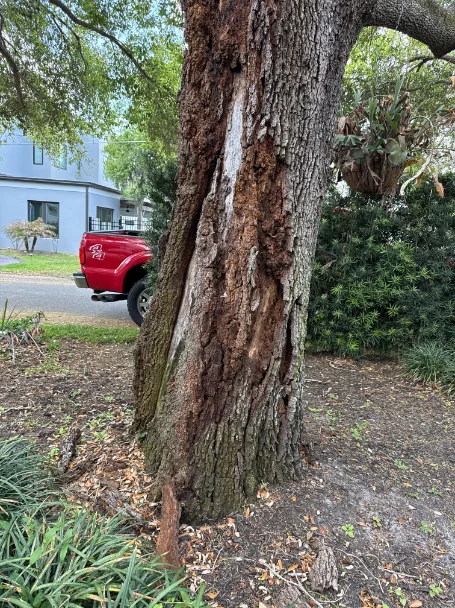
Severe decay and bark loss in a mature oak.
Laurel Oak
Laurel oaks are one of the most commonly concerning trees in the Orlando area because they can look healthy while developing internal decay. They often age poorly compared to stronger long-lived oaks, and many homeowners do not realize there is a problem until limbs begin failing or the trunk shows visible decline.
These trees can carry a full canopy while hiding serious structural weakness inside, making them especially concerning near homes, driveways, patios, and other target areas.
- Shorter lifespan than live oaks
- More prone to hidden decay and structural decline with age
- Large limb failure and whole-tree failure are common storm concerns
Field insight: Laurel oaks are one of the trees that most often surprise homeowners because they may still look green and full right up until failure becomes obvious.
Best advice: Large mature laurel oaks near homes should be watched closely and evaluated before storm season, especially if there are signs of bark loss, cavities, deadwood, or trunk decay.
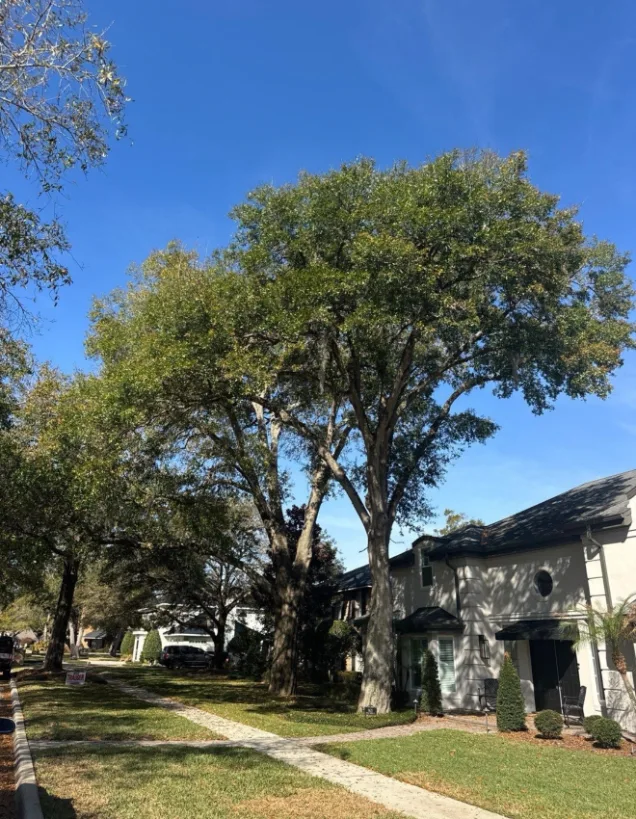
Trees too close to homes increase risk.
Water Oak
Water oaks grow relatively fast and can provide useful shade, but they often develop weaker structure than stronger long-lived species. In residential settings, they become more concerning when limbs extend over roofs, vehicles, driveways, screen enclosures, or other meaningful targets.
Even when a tree is still alive and leafed out, weak branch attachments, neglected pruning, and long overextended limbs can make storm failure much more likely. That risk becomes more serious when the tree is close to the home.
- Can shed large limbs in wind
- Often develops structural weakness over time
- Risk increases when neglected or growing too close to structures
Field insight: Trees do not need to be dead to be dangerous. Location alone can make a structurally weaker tree much more serious when it hangs over a roof or driveway.
Best advice: Watch for deadwood, included bark, long horizontal limbs, and overhang above roofs or driveways. Even a tree that appears “pretty good” can still have a poor risk profile because of where it is located.
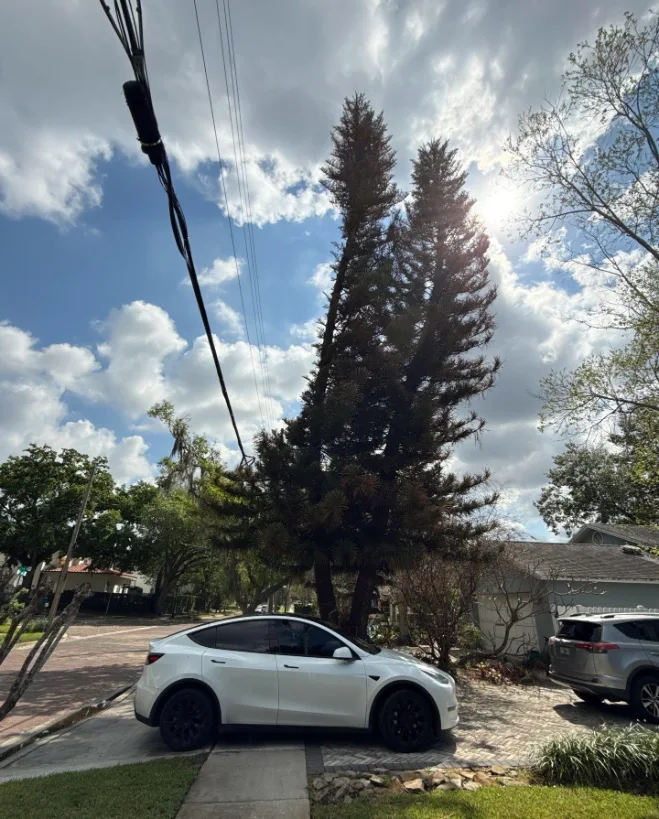
Top break-out is a common storm failure pattern.
Sand Pine
Sand pines are a familiar storm concern in parts of Central Florida, but in our experience the failure pattern is often not full uprooting. More often than not, what we see is the upper portion of the tree cracking out and falling, sometimes with the top 15 to 20 feet breaking free during wind events.
That falling top can still cause major damage on the way down to roofs, fences, vehicles, or neighboring property. And once the top breaks out, the remaining tree is often left unsafe or disfigured enough that full removal becomes the practical next step anyway.
- Top break-out is a common storm failure pattern
- Tall narrow structure can create upper canopy stress
- Damage often occurs from falling tops rather than full uprooting
Field insight: This is one of those trees where the upper portion can create the real problem. Even if the base stays standing, the damage from the top coming out can still be severe.
Best advice: Sand pines close to homes, power lines, or tight access areas deserve serious attention before storms arrive, especially when the upper canopy shows decline or structural weakness.
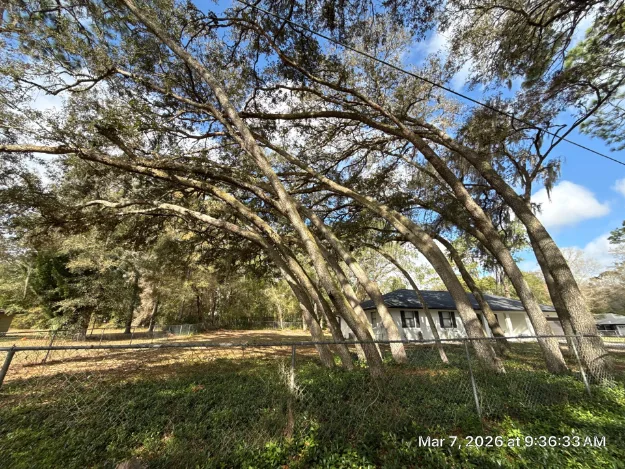
Even strong oaks can become hazardous when poorly maintained.
Poorly Maintained Live Oaks
Live oaks are among the strongest and most valuable trees in our area, but they are not maintenance-free. A large live oak can still become hazardous when it has excessive end weight, poor past pruning, structural defects, storm wounds, or canopy imbalance over a target.
This is especially true on residential properties where major limbs extend over a roof, driveway, or neighboring yard. A strong species does not automatically mean low risk. The condition, structure, and target area still matter.
- Heavy overextended limbs can fail
- Poor past pruning can create imbalance
- Decay, storm wounds, and overhang can change the risk profile
Field insight: Live oaks are often worth preserving, but preserving them correctly requires real pruning standards — not random cutting for quick clearance.
Best advice: A mature live oak should be managed with proper pruning standards, not hacked back for quick clearance. Good pruning is about structure, weight distribution, and long-term health.
Other Trees That Can Become Risky in the Right Conditions
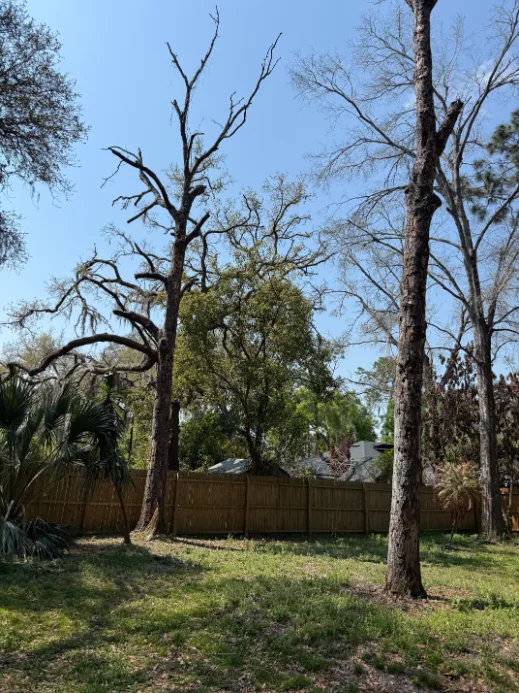
Dead or declining trees become brittle and unpredictable, especially during storms.
Not every dangerous tree is obvious. Some of the highest-risk situations we see involve trees that homeowners did not think were a major problem at all.
Some trees are not automatically at the top of the Central Florida risk list, but they can still become dangerous when they are overgrown, storm-damaged, poorly structured, or positioned near meaningful targets like homes, driveways, fences, and power lines.
In other words, species matters, but condition and location matter too. A tree that might be manageable in an open area can become a serious concern when it is declining or hanging over a structure.
- Sweetgum: Can develop heavy end weight, long overextended limbs, and messy neglected structure near homes and driveways.
- Some maples: May develop weak unions, co-dominant stems, included bark, or storm-related structural defects.
- Previously topped trees: Almost any species becomes riskier after topping because of weak regrowth and increased decay potential.
- Storm-damaged trees: A species that is normally manageable can quickly become hazardous after a split, major limb failure, lightning strike, or root damage.
Best advice: Do not judge risk by species name alone. Look at the structure, the defects, the pruning history, and what the tree could hit if it fails.
Warning Signs a Tree May Be Dangerous
Leaning trees can point to stability issues, root problems, or higher storm-failure risk.
Most tree failures do not happen randomly. In many cases, the warning signs were already there — they just were not recognized or addressed in time.
Homeowners often ask whether there is a simple way to tell if a tree is dangerous. There is no single sign that tells the whole story, but there are several red flags that deserve closer attention — especially before storm season.
- Leaning tree: A noticeable lean, especially if it appears recent, can suggest stability problems or root issues.
- Cracks or splits: Structural cracks in the trunk or large limbs can indicate weakness that may worsen under load.
- Dead branches: Deadwood, hanging limbs, and canopy thinning often point to decline or increased limb-failure risk.
- Decay or fungus: Cavities, bark loss, mushrooms, and fungal growth can all be signs that structural wood is compromised.
- Root-zone movement: Lifting soil, exposed roots, or a shifting root plate after heavy rain can indicate instability.
- Past storm damage: Trees that have already lost major limbs may have hidden defects that are not obvious from the ground.
What we see in the field: Many of the trees removed after storms had visible signs beforehand — lean, dead limbs, cracks, bark loss, or canopy decline — but those signs were easy to ignore until failure actually happened.
Best advice: A tree does not need to look completely dead to be dangerous. Some of the highest-risk trees still have green leaves and a full canopy while serious defects are developing inside.
What You Can Do to Reduce Tree Risk
Not every concerning tree needs to be removed. In many cases, thoughtful pruning, monitoring, and proactive planning can significantly reduce risk. The key is acting early instead of waiting until a tree becomes an emergency.
Schedule Evaluations
Large trees near roofs, patios, driveways, fences, and neighboring property deserve closer attention before storm season.
Prune Deadwood
Removing dead limbs and addressing excessive end weight can reduce stress when the tree is still worth preserving.
Avoid Topping
Improper pruning often creates weak regrowth and larger structural problems later.
Act Early
It is far better to address a risky tree before wind, rain, and emergency conditions arrive.
There are also cases where removal is the better option. If a tree has advanced decay, major structural defects, severe decline, or a target area that makes failure unacceptable, removal may be the safer long-term decision.
Best advice: If you are trying to decide between trimming and removal, our Orlando Tree Removal Cost Guide explains what goes into a professional removal, and our tree trimming page explains when pruning may still be a good option.
Protecting Your Property During Tree Work
Hazardous trees near structures require careful planning, controlled work, and property protection.
When a hazardous tree is close to a home, fence, driveway, pool enclosure, or landscaping, the work is not just about the tree itself. It is also about how the job is planned and how the property is protected while the work is being performed.
At Kevin’s Tree Service, we use our KTS Property Shield™ approach to help reduce unnecessary damage during trimming and removal work. That includes thoughtful access planning, controlled lowering when needed, organized debris handling, and protective measures around vulnerable surfaces.
Best advice: When comparing quotes, do not look only at price. The quality of planning, cleanup, and property protection can make a major difference in how the job goes and how your yard looks afterward.
Request a Free On-Site Quote
If you’re concerned about a hazardous or storm-risk tree, our team can review the tree, explain the available options, and provide a clear quote based on your property conditions.
Kevin’s Tree Service provides professional tree removal, trimming, stump grinding, and arborist-led tree care throughout the Orlando area.