Tree Topping in Orlando: Why It Harms Trees and What to Do Instead
Topping can look like a quick way to make a tree smaller or “storm-ready.” It usually does the opposite. Here is what topping does to a tree, what to ask for instead, and how to spot a proposal that recommends the wrong work.
By Kevin’s Tree Service · Central Florida tree care
The quick answer
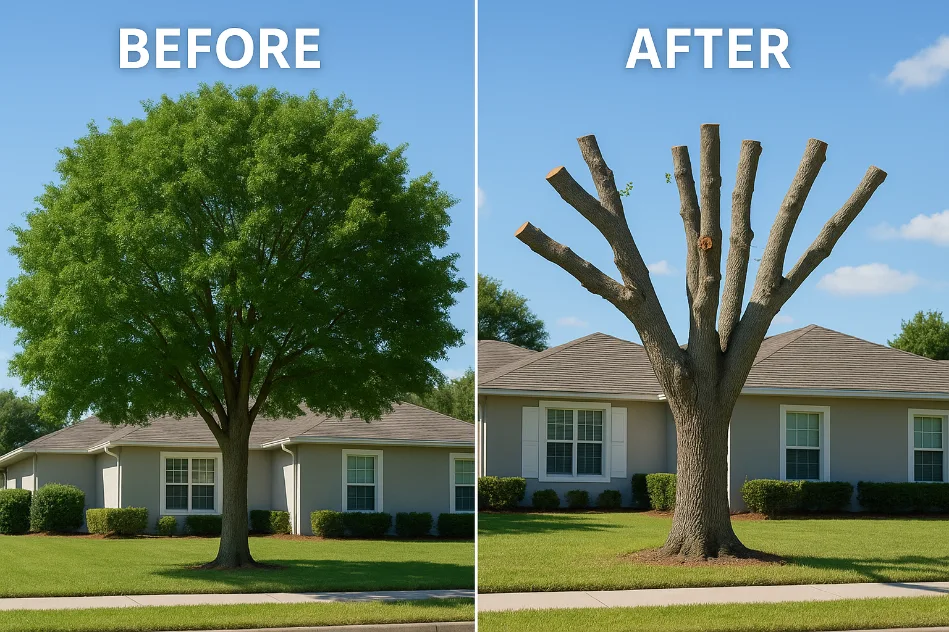
Topping cuts large branches or leaders back to stubs. It removes much of the leaf area the tree needs, leaves large wounds that can decay, and produces fast, weakly attached regrowth. When a tree needs to be smaller or clear of the house, ask for crown reduction to suitable lateral branches, structural pruning or, where pruning cannot meet the goal, removal.
What counts as topping
Topping, also called heading or hat-racking, cuts branches or the main leader back to stubs or to branches too small to take over. It is not the same as professional pruning or proper crown reduction.
Rule of thumb: if large limbs are cut to blunt stubs instead of being shortened back to a strong lateral branch, that is topping.
What happens after topping
Right after the cut
The tree looks smaller, more light reaches the yard and it can feel as if storm risk has gone down.
In the following years
Dense, weakly attached shoots grow back from the cuts, decay can enter large wounds, and the tree often needs more frequent and more expensive work, or earlier removal.
Why topping harms trees
1. It removes the tree’s food supply
Leaves produce the energy a tree needs. Removing a large share of the canopy at once puts the tree under stress and can leave it more vulnerable to pests and disease.
2. It exposes bark to the Florida sun
Sudden canopy loss exposes bark that was shaded, which can lead to sunscald and cracking in strong Central Florida sunlight.
3. It produces weak regrowth
Shoots that sprout below topping cuts grow quickly but attach poorly. As they get heavier, they are more likely to break, especially in storms.
4. It invites decay
Large topping wounds are hard for a tree to close off. Decay can spread inside the stubs and weaken the structure over time.
5. It costs more in the long run
Topped trees lose their natural form and usually need repeated corrective pruning. Some never recover and have to be removed.
What to do instead
| Goal | Better approach |
|---|---|
| Make the tree smaller | Crown reduction: shorten selected branches back to suitable lateral branches. |
| Clear the roof, driveway or walk | Canopy raising and selective clearance pruning. See canopy raising and crown reduction. |
| Reduce storm risk | Structural pruning and removal of dead, broken or poorly attached branches, based on the tree’s actual defects. |
| The tree is wrong for the space | Consider removal and a replacement that fits the site, rather than topping it again and again. |
Crown thinning should be limited. Stripping too much interior foliage can weaken a tree, just as topping does.
How to check a pruning proposal
- Ask which branches will be cut and how much foliage will remain.
- Ask whether cuts go back to suitable lateral branches or to stubs.
- Be cautious of a quote that promises to “top” or “hurricane-cut” a tree to make it safe.
- Ask who reviews the plan. Kevin’s Tree Service works with ISA Certified Arborist oversight and follows ANSI A300 pruning practices.
For tree trimming in Orlando, see our Orlando tree trimming and pruning page. If you are worried about a tree’s condition, read the dangerous trees guide.
Common questions
Does topping make a tree safer in a storm?
Not over time. Regrowth from topping cuts is weakly attached, and large wounds can decay, so a topped tree can become more likely to break. Storm preparation should address actual defects and selected branches instead.
What is the difference between topping and crown reduction?
Topping cuts branches or leaders back to stubs or to small branches that cannot take over. Crown reduction shortens selected branches back to suitable lateral branches, which preserves the tree’s structure and natural form.
Can a topped tree recover?
Some trees survive, but many develop decay and weak regrowth. Restoration pruning over several years can select and space the strongest new branches. In some cases, removal and replacement is the safer choice.
What if a tree is simply too big for its spot?
Ask whether reduction to suitable laterals can meet the goal. If it cannot, removing the tree and planting a species that fits the space is usually better than repeatedly topping it.
Does Kevin’s Tree Service top trees?
No. Kevin’s Tree Service does not top trees. We follow ANSI A300 pruning practices with ISA Certified Arborist oversight.
Is an arborist assessment included in a free estimate?
Tree-work estimates are free. Arborist assessments, consultations and letters are separate paid services; confirm the service you need when booking.
Have a tree question about your property?
Tell us what you are planning and what has changed. We’ll help define the tree-work scope.
Get a Free EstimateOn-site tree-work estimates are free. Arborist assessments and letters are separate paid services.


