
FAQ · Greater Orlando & Central Florida
Tree Service FAQs
Straight answers about estimates, scheduling, safety, payment, permits and stump grinding. Don’t see your question? Call us or request a free on-site estimate.
Phones Answered 24/7
Office hours Monday–Friday, 8 am–4 pm.
- 4.8 ★ on GoogleOver 1,000 Google reviews
- ISA Certified ArboristProfessional Oversight
- Fully insuredGeneral liability + workers’ comp
- Since 1987Family-owned, based in Oviedo
Estimates & Scheduling
How do I schedule a free on-site estimate?
Call or text (407) 971-7714, or use our online request form. We’ll confirm your address, goals and access notes, then set a time to walk the property with you. In many cases you’ll receive a written quote during that visit. Photos, a gate code and any HOA requirements you already know about help us plan.
How soon can you come out?
Most estimates are booked within 24–48 hours. Work is scheduled based on scope, weather and equipment needs, and safety issues and storm damage are prioritized.
Will someone walk the property with me?
Yes. We review the tree’s species and structure, what’s nearby (homes, screens, driveways), access paths and your goals before recommending pruning or removal.
Can you text me updates?
Yes. We can coordinate by phone, email or text at (407) 971-7714, whichever is easiest for you.
What if a tree falls or storm damage can’t wait?
Call (407) 971-7714. Our phones are answered 24/7, and storm damage and safety issues are prioritized when we schedule work. Until we arrive, keep people and pets away from the tree and stay well clear of any downed or sagging power lines. Report those to your electric utility right away, because lines tangled in a tree can still be energized. If you plan to file an insurance claim, take photos before anything is moved. See Emergency Tree Removal.
When is the best time to trim trees in Central Florida?
Most trees here can be pruned any time of year, but many homeowners schedule trimming before hurricane season (June 1 through November 30) so deadwood and weak or overextended limbs are dealt with before storms. How often a tree needs pruning depends on the species, its age and how close it is to your roof, driveway or lines. Avoid “topping,” which weakens trees and creates more storm risk. See How Often Should You Trim Your Trees? and Tree Trimming.
Safety & Standards
Is an ISA Certified Arborist involved?
Yes. Our work is overseen by our ISA Certified Arborist, who helps plan pruning and removals to protect tree health and nearby structures. ISA certification is an individual credential from the International Society of Arboriculture that requires passing an exam and keeping up with continuing education. Learn more on our Certified Arborist page.
How can I tell if a tree might be dangerous?
Common warning signs include a new or worsening lean, cracks or splits in the trunk or large limbs, dead or hanging branches, mushrooms or cavities near the base, lifting soil or exposed roots after heavy rain, and large limbs lost in a past storm. Central Florida’s sandy soil, heavy rain and strong storms make these signs worth acting on early, especially when the tree is over a home, driveway or pool enclosure. If you notice any of them, schedule an evaluation before storm season. See Dangerous Trees in Orlando.
Should I trim my tree or remove it?
It depends on the tree’s condition and your goals. A structurally sound tree with a few problem limbs can often be kept with proper pruning, such as removing deadwood, reducing weight over a roof or raising the canopy. Removal is usually the safer choice when there’s significant decay, a dangerous lean, major storm damage or root failure. At your free estimate we’ll look at the tree’s health, its structure and what it could hit, then recommend pruning or removal and explain why. See Tree Trimming and Tree Removal.
How do you protect lawns, pavers and pool screens?
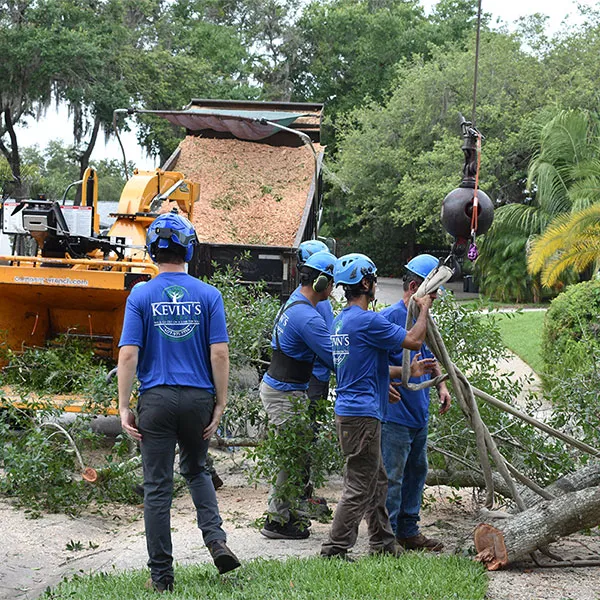
Every job starts with an access plan. We use ground-protection mats where site conditions call for them and lower large limbs in controlled pieces instead of dropping them near structures. Spotters watch screens, fences, A/C units and service lines. Equipment is matched to the site: our compact spider lift fits through narrow backyard access, and our grapple saw crane can lift sections over a home instead of dragging them across the lawn. See KTS Property Shield.
When do you recommend a crane?
When it reduces risk and lawn impact, such as large trees over homes or pool cages, limited drop zones or storm-damaged wood that isn’t safe to climb. We own and operate a Fassi grapple saw crane, which cuts and lifts sections in one controlled motion, and we arrange larger cranes when a job requires one. If a crane isn’t the best fit, we’ll explain a rigging plan that meets the same protection goals. See Crane Service and Grapple Truck Service.
Pricing & Payment
How much does tree removal cost in the Orlando area?
Every job is priced individually after a free on-site estimate. The biggest factors are the tree’s size and trunk diameter, access to it, what it’s near (homes, fences, pools, power lines), its condition, whether a crane or specialty equipment is needed, and how much cleanup and stump work you want. Storm-damaged or hazardous trees often take more time and precautions. For typical price ranges and real examples, see our Orlando Tree Removal Cost Guide and Tree Trimming Cost Guide.
Are estimates free?
Yes. On-site estimates for tree work are free and include a clear written scope and price. Certified arborist assessments and letters are paid services, with pricing included in your written estimate.
What are the payment terms?
Payment in full is due when the work is completed. We accept common payment methods, and financing is available for qualified customers.
What exactly is included in the price?
Your written estimate spells out the job: the trees and work involved (pruning or removal), protection measures, and any add-ons you choose, such as stump grinding, chip haul-away or backfill. Debris haul-away is included when it’s listed in your estimate. The written scope is what you’re agreeing to, so if something isn’t listed, ask us before work starts.
Do you offer financing?
Yes, through Wisetack for qualified customers. See our Financing page for details and to pre-qualify.
Permits, HOA & Insurance
Do I need a permit to remove a tree?
It depends on where you live and the tree. Cities and counties in the Orlando area set their own rules on things like tree size, species and lot type, so the same tree can need a permit in one city and not the next. When a permit is required, Kevin’s Tree Service can assist with tree removal permit applications. Separately, under Florida Statute 163.045, qualifying trees on eligible single-family residential properties may be exempt from local government notice, application, permit, approval, fee, mitigation and replanting requirements when a signed onsite tree risk assessment, performed under ISA risk assessment procedures, establishes that the tree presents an unacceptable risk. Our ISA Certified Arborist can perform that assessment. That documentation is different from an ordinary arborist letter, and not every tree qualifies. Because rules change, confirm requirements with your city or county. See Do I Need a Permit to Remove a Tree in Orlando?
Can you help with HOA approvals?
Yes. Scope notes, photos and certificates of insurance are available to support HOA submissions. HOA approval is separate from city or county permits. Many Central Florida communities require it even when no government permit is needed, and the state law covering local permits doesn’t address HOA rules. Check your covenants or ask your management company before scheduling.
Are you insured?
Yes. We carry General Liability and Workers’ Compensation insurance. General liability insurance is for property damage caused by our work, and workers’ compensation is for injuries to our crew on the job. Certificates are on our Insurance page and available on request, including for HOAs and property managers.
Will my homeowners insurance pay for tree removal?
Sometimes. It depends on your policy and why the tree came down. Policies more often cover removal when a covered event, such as a windstorm, causes a tree to fall on an insured structure like your house or a fence, or to block your driveway. Trees that fail because of decay or neglect, and trees removed as a precaution, are often not covered, and many policies cap tree removal coverage. Check with your insurance agent before work starts. We can provide a written estimate and invoice for your records, plus job photos when available.
Stumps & Cleanup
Do you offer same-day stump grinding?
Often, yes, depending on access and schedule. Ask about pairing stump grinding with your removal so everything is handled in one visit.
How deep do you grind stumps, and what happens to the roots?
We grind the stump below ground level so the area can be covered and mowed, typically about 4–12 inches below grade depending on site conditions and the agreed scope. Grinding large surface roots can be included when you request it and it’s part of the agreed scope. The roots that remain underground break down naturally over time. If you’re planning to build, pour concrete or install a pool or pavers where the tree stood, tell us at the estimate so we can plan the grinding accordingly. See Stump Grinding vs. Stump Removal.
What are my options for chips and backfill?
We can leave the chips neatly mounded to settle, or haul them away and backfill the hole. Topsoil and grading are available if you’d like the area leveled.
Any risks to underground lines when grinding?
Yes. Stump grinding can damage underground utilities, irrigation lines, landscape lighting, and other buried systems. During your estimate, our salesperson evaluates the work area and identifies whether a Sunshine 811 utility locate is needed. When required, our team coordinates the locate before grinding. Because Sunshine 811 generally does not mark privately owned lines, homeowners should identify any known irrigation, electrical, pool, septic, or other private underground lines before work begins.
Where We Work
What areas do you serve?
We’re based in Oviedo and serve most of Seminole and Orange counties, including Orlando, Winter Park, Winter Springs, Oviedo, Longwood, Maitland, Sanford, Altamonte Springs, Lake Mary and Windermere. See the Service Areas page for the current list, or call (407) 971-7714 to check your address.
Still have a question?
Tell us about your trees and add a few photos. We’ll answer your questions at your free on-site estimate.
Get My Free EstimateExplore Services & Areas
Popular services
Nearby cities
Not your city? See all Service Areas.


