
Florida Oak Trees: A Central Florida Homeowner’s Guide
Learn how to identify live oaks, laurel oaks, and water oaks, how long they live, common problems to watch for, and how to properly care for the oak trees on your Central Florida property.
What Are the Most Common Oak Trees in Central Florida?
Live oak, laurel oak, and water oak are three oak species Central Florida homeowners commonly encounter. Although they can look similar from a distance, they have very different lifespans, growth habits, structural characteristics, and long-term maintenance needs.
ISA Certified Arborist-Led • Proper Oak Pruning • Tree Risk Evaluations • KTS Property Shield™
Oak trees are a defining part of the Central Florida landscape. They shade homes, line older neighborhoods, support wildlife, and in the case of a mature live oak, may have been growing on the property long before the house was ever built.
But not every oak is the same. A healthy mature live oak may have generations of useful life ahead of it, while a similarly sized laurel oak or water oak may be approaching an age when decay and structural problems deserve much closer attention.
That difference is important for homeowners. Before deciding whether an oak needs pruning, monitoring, or removal, it helps to first understand what kind of oak you actually have.
This guide focuses on three of the oaks we commonly encounter throughout Orlando and Central Florida: live oak, laurel oak, and water oak. We will explain how to tell them apart, their typical lifespan and growth habits, common problems, storm considerations, pruning needs, and signs that an oak deserves a closer professional evaluation.
If you already have concerns about an oak on your property, learn more about our ISA Certified Arborist evaluations, tree trimming services, and tree removal services in Orlando.
Why Knowing Your Oak Species Matters
Homeowners often refer to every large spreading oak simply as an “oak tree,” but species can make a major difference when evaluating the tree’s long-term outlook.
Lifespan
A properly located live oak can potentially live for centuries, while laurel and water oaks generally have much shorter expected lifespans.
Decay Resistance
Some oak species resist decay better than others. Laurel and water oaks can become increasingly prone to internal deterioration as they mature.
Storm Performance
Live oak is considered one of Florida’s more wind-resistant large trees, while species, structure, defects, pruning history, and location all influence actual storm risk.
Pruning Needs
Proper structural pruning while trees are younger can reduce the need for large cuts later and help develop stronger branch architecture.
Size & Location
Large oak trees need substantial room for both their canopy and root system. Trees planted too close to structures may create conflicts as they mature.
Removal Decisions
Age alone should not determine whether an oak is removed. Species, structure, decay, roots, targets, and overall condition should all be considered.
In other words, identifying the species gives you important context — but the individual condition of the tree still matters more than the name alone.
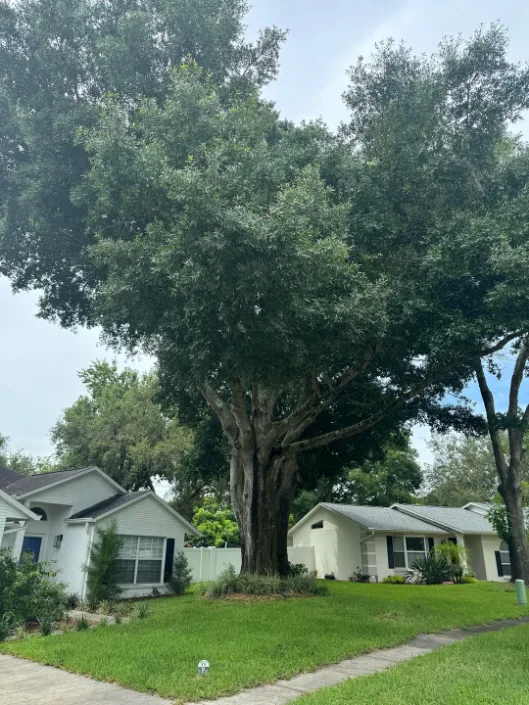
Mature live oaks can develop massive spreading canopies.
Live Oak: The Long-Lived Florida Classic
Live oak (Quercus virginiana) is one of the most recognizable and valuable trees in Florida. Mature live oaks develop broad, spreading canopies, heavy horizontal limbs, deeply furrowed bark, and the classic appearance homeowners often associate with Spanish moss hanging from the branches.
Under good growing conditions, live oaks commonly reach approximately 60 to 80 feet tall and can spread 60 to 120 feet wide. Their canopy can eventually become wider than the tree is tall.
One of the most important differences between a live oak and many other common Central Florida oaks is longevity. A properly situated live oak can survive for hundreds of years. That means a mature live oak should not automatically be considered “old” or ready for removal simply because it is large.
- Long-lived species capable of surviving for centuries
- Typically develops a massive spreading canopy
- Generally considered highly wind-resistant when structurally sound
- Often worth preserving when properly located and maintained
- Can eventually require significant room for canopy and roots
Field insight: Some homeowners become nervous simply because a live oak is extremely large. Size alone does not necessarily make a live oak dangerous. We are much more interested in the tree’s structure, root condition, pruning history, decay, major limb attachments, and what is located beneath the canopy.
Best advice: If a mature live oak is healthy and structurally sound, preservation is often the preferred option. Proper pruning and periodic evaluation can help manage clearance and structural concerns without unnecessarily removing a valuable long-lived tree.
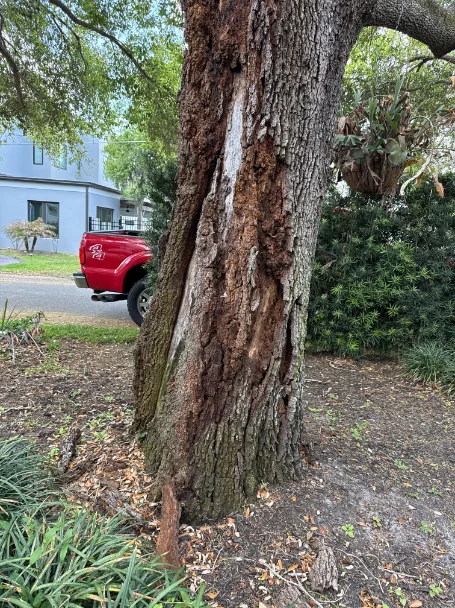
Decay becomes an increasingly important concern in aging laurel oaks.
Laurel Oak: Fast Growing, but Much Shorter Lived
Laurel oak (Quercus laurifolia) is another very common oak throughout Central Florida. It grows quickly, develops a dense canopy, and can become a large shade tree in a relatively short period of time.
That fast growth is one reason laurel oaks became common in residential areas, but they do not typically have the longevity of live oaks. UF/IFAS describes the normal lifespan of a laurel oak as approximately 50 to 70 years.
As laurel oaks mature, decay becomes increasingly important. Trunks and large limbs can hollow internally, and injuries or large improper pruning cuts can allow long columns of decay to develop inside the tree.
- Fast-growing large shade tree
- Commonly reaches 60 feet or more in height
- Typical lifespan around 50 to 70 years
- More susceptible to internal decay as it matures
- Large pruning wounds can contribute to future deterioration
Field insight: Laurel oaks are one of the species that can surprise homeowners. A tree can still be green and carrying a substantial canopy even while serious deterioration is developing in the trunk or major limbs.
This does not mean every 50-year-old laurel oak needs to be removed. It does mean age becomes more meaningful when it is combined with cavities, bark loss, fungal growth, deadwood, major limb failures, cracks, root problems, or other signs of decline.
Best advice: If you have a large mature laurel oak near your home, driveway, pool enclosure, or other important target, periodic evaluation becomes increasingly worthwhile as the tree ages.
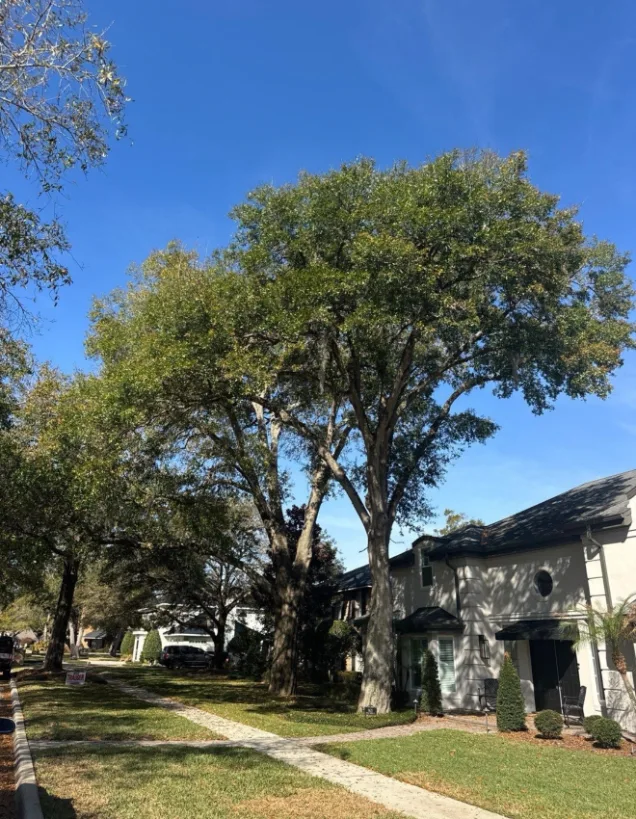
Large mature oaks deserve closer attention when positioned over homes and other targets.
Water Oak: Fast Growth With a Shorter Lifespan
Water oak (Quercus nigra) is another fast-growing Southern oak that can reach approximately 60 to 80 feet tall with a similarly broad spread.
Water oaks naturally occur in wetter environments, although they can also be found in residential landscapes. Their leaves can be somewhat variable, but many have a distinctive shape that is narrower toward the base and wider toward the end, sometimes described as spoon- or spatula-shaped.
The biggest long-term concern is lifespan and decay. Water oaks typically live around 30 to 50 years, and UF/IFAS notes that they can begin breaking apart at maturity because of rot.
- Fast-growing shade tree
- Often 60 to 80 feet tall at maturity
- Typical lifespan around 30 to 50 years
- Can become increasingly susceptible to rot as it matures
- Age and structural condition deserve close attention near homes
Field insight: With water oaks, a homeowner should not rely entirely on whether the tree still has leaves. Structural condition can become the more important question as an older tree approaches maturity.
Best advice: Older water oaks located over houses, vehicles, fences, driveways, or areas where people regularly spend time deserve a closer look, particularly if there has already been limb failure, canopy decline, cavities, or visible decay.
Live Oak vs. Laurel Oak vs. Water Oak
From the street, these trees can sometimes look similar. The differences become much more obvious when you compare their expected lifespan, canopy shape, leaves, and long-term decay characteristics.
| Characteristic | Live Oak | Laurel Oak | Water Oak |
|---|---|---|---|
| Scientific name | Quercus virginiana | Quercus laurifolia | Quercus nigra |
| Typical lifespan | Centuries possible | About 50–70 years | About 30–50 years |
| Growth rate | Moderate | Fast | Fast |
| Mature size | 60–80 ft tall; very wide spread | 60+ ft tall; dense oval canopy | 60–80 ft tall; broad canopy |
| Decay concern with age | Generally lower when healthy | Higher | Higher |
| General preservation outlook | Often highly worth preserving | Depends heavily on age and condition | Depends heavily on age and condition |
These are general species characteristics, not a diagnosis of an individual tree. Trees of the same species can have very different risk profiles depending on structure, site conditions, roots, pruning history, damage, and decay.
How Can I Tell What Kind of Oak Tree I Have?
Tree identification can be more difficult than it looks. Leaves are helpful, but you should not rely on a single leaf because shape can vary, particularly on water oaks and on different parts of the same tree.
Instead, look at several characteristics together:
Look at the Leaves
Live oak leaves are generally small and oval. Laurel oak leaves tend to be narrow, smooth, and shiny. Water oak leaves are more variable but often widen toward the tip.
Look at the Canopy
Mature live oaks commonly have a huge spreading canopy with long horizontal limbs. Laurel oaks often develop a denser oval crown.
Look at the Bark
Bark texture and color change as trees mature, but older live oaks usually develop deeply furrowed gray to dark bark.
Look at the Acorns
Acorn shape, size, cup structure, and whether they occur singly or in groups can help distinguish one oak species from another.
Best advice: Do not make a major pruning or removal decision based on an identification app or a single leaf photograph. If the species matters to the decision, have the tree identified with multiple characteristics.
Why Is My Oak Tree Dropping So Many Leaves?
One of the most common concerns we hear from homeowners is that an oak suddenly begins dropping a large amount of leaves and they assume the tree is dying.
Sometimes leaf loss is normal.
Live oaks are often described as evergreen because they do not typically become completely bare like a northern deciduous oak. But they still replace older foliage. In Central Florida, homeowners may notice substantial leaf drop around the same general period that new spring growth begins.
Laurel oaks are considered semi-evergreen and may also hold much of their foliage until late winter or early spring before shedding.
Normal leaf drop should be distinguished from canopy decline. A tree that sheds older foliage and quickly produces healthy new growth is very different from a tree developing progressively larger bare sections, dead branch tips, thinning foliage, or entire dead limbs.
More concerning signs include:
- Large dead sections of canopy
- Major limbs that never leaf back out
- Progressive thinning over multiple seasons
- New cracks, cavities, or bark loss
- Mushrooms or fungal fruiting bodies around the trunk or roots
- Sudden decline following construction or root damage
Best advice: Leaf drop by itself does not tell you whether an oak is healthy or unsafe. Look at the overall canopy, branches, trunk, roots, and whether normal new growth follows.
Is Spanish Moss Killing My Oak Tree?
Usually, no. Spanish moss is one of the most misunderstood things growing in Florida trees.
Spanish moss is not actually a moss and it is not a parasite. It is an epiphyte, meaning it uses the tree primarily for support while obtaining moisture and nutrients from the air and rainwater.
That means Spanish moss is not sending roots into your oak and stealing nutrients from it.
There is, however, a reason homeowners sometimes associate heavy Spanish moss with declining trees. When an oak begins losing foliage for another reason, more sunlight reaches the interior branches. Spanish moss can then grow more heavily in those newly exposed areas.
So the moss may become more visible because the canopy is declining rather than being the cause of the decline.
Extremely heavy accumulations can add weight or shade some foliage, but on a healthy tree the impact is generally limited.
Field insight: When we see a tree covered with Spanish moss, our first question is not “How do we remove the moss?” It is “Why does the canopy look the way it does?”
Best advice: Do not assume removing Spanish moss will fix a declining oak. The underlying health and structural condition of the tree are more important.
Mushrooms, Cavities, and Decay in Oak Trees
Mushrooms or fungal structures growing on or around a mature oak deserve attention, particularly when they appear repeatedly at the base of the trunk, on major roots, or directly from damaged wood.
Not every mushroom means the tree is about to fall. Fungi are everywhere in the landscape, and some are simply decomposing organic matter in the soil or mulch.
The concern changes when fungal fruiting bodies are associated with structural wood or major roots.
Other signs that deserve closer inspection include:
- Large trunk cavities
- Soft, punky, or crumbling wood
- Sections of missing or sloughing bark
- Open wounds that are not closing over
- Visible hollows inside major limbs
- Repeated mushrooms at the trunk flare or root zone
- Woodpecker activity concentrated around deteriorating wood
A hollow tree is not automatically unsafe. Trees can sometimes remain structurally functional with cavities for many years. What matters is how much sound wood remains, where the defect is located, how the tree is loaded, and what could be struck if that part fails.
Best advice: Do not poke at a cavity, fill it with concrete, seal it with paint, or assume the problem can be judged by looking only at the opening. Structural decay is often more complex than what is visible from outside.
Oak Tree Roots Near Homes, Driveways, and Sidewalks
Large oak trees require a large amount of rooting space. As a tree matures, major surface roots may become increasingly visible and can eventually create conflicts with sidewalks, curbs, patios, driveways, irrigation systems, and landscaping.
That does not mean roots should simply be cut whenever they become inconvenient.
Large root cutting can affect both tree health and stability. The closer a major root is to the trunk, the more important it may be to the structural support of the tree.
Construction can create similar problems. Trenching for irrigation, utilities, drainage, fences, pools, additions, and driveway work can damage roots without creating an obvious problem in the canopy immediately.
Root-related warning signs include:
- Major roots recently cut or trenched
- Soil lifting on one side of the tree
- New leaning following heavy rain or construction
- Decay at the root flare
- Large roots damaged by vehicles or excavation
- Sudden canopy decline after site work
Best advice: If a large oak root is causing a conflict, evaluate the tree before cutting the root. Saving a sidewalk or irrigation line is not worth unintentionally destabilizing a mature tree beside the house.
How Should Oak Trees Be Trimmed?
Good oak pruning is not about making the tree smaller everywhere. It is about addressing specific objectives while preserving natural structure and as much healthy foliage as practical.
Depending on the tree, proper pruning may include:
Deadwood Removal
Removing dead, broken, dying, or hanging limbs that create an unnecessary risk over target areas.
Structural Pruning
Managing competing stems, poor attachments, and developing branch structure while the tree is young enough for smaller cuts.
End-Weight Reduction
Selective reduction of overextended limbs when there is a legitimate structural reason to reduce leverage.
Clearance Pruning
Creating reasonable separation from roofs, buildings, streets, driveways, and other areas without unnecessarily stripping the canopy.
What oak trees generally do not benefit from is indiscriminate topping or severe lion-tailing.
Tree topping removes branches without regard to proper attachment points, creates large wounds, encourages poorly attached regrowth, and can contribute to decay and long-term structural problems.
Field insight: With a large oak, the goal should rarely be “take as much out as possible.” More pruning is not automatically better pruning.
Best advice: Pruning should have a reason. If nobody can explain why a particular limb needs to be removed and what the cut is intended to accomplish, it is worth reconsidering the cut.
Should You Thin an Oak Before Hurricane Season?
Homeowners are often told that aggressively thinning a tree will “let the wind blow through it.” That idea can lead to excessive pruning that removes far more living canopy than necessary.
Proper storm preparation is more targeted.
For a mature oak, we are generally more interested in:
- Dead or broken limbs
- Cracked or poorly attached branches
- Excessive end weight on long overextended limbs
- Canopy imbalance
- Previous storm damage
- Structural defects
- Decay in trunks or major unions
- Root or soil problems affecting stability
Live oaks have performed very well in Florida wind-resistance research, but even a strong species can fail when it has major structural defects or has been poorly maintained.
Likewise, an older laurel or water oak may warrant more attention because the species is shorter lived and more susceptible to decay as it matures.
Best advice: Hurricane preparation should focus on defects and structure — not simply removing a percentage of the canopy.
If you are concerned about how a tree may perform during severe weather, also read our Dangerous Trees in Orlando: Storm Risk Guide for Homeowners.
When Should an Oak Tree Be Removed?
Age alone is not a reason to remove an oak tree.
This is particularly important with live oaks. A large live oak may already be many decades old and still have the potential for an extremely long remaining life.
With laurel and water oaks, age plays a larger role because their typical lifespan is considerably shorter. But even then, removal decisions should be based on the complete picture rather than the birthday of the tree.
Removal becomes more reasonable when several serious concerns begin to overlap, such as:
- Advanced trunk or root decay
- Major structural cracks or splitting
- Significant root failure or root-plate movement
- Progressive canopy decline
- Repeated large limb failures
- Major storm damage that cannot reasonably be corrected
- Severe structural defects combined with a high-value target
- A declining short-lived oak located directly over a home or occupied area
There are also situations where retaining the tree may still be reasonable through pruning, monitoring, or other management strategies.
Field insight: We do not believe every imperfect oak needs to come down. Trees naturally have scars, cavities, leans, deadwood, and unusual structure. The real question is whether those conditions create an unacceptable likelihood and consequence of failure.
Best advice: If you are deciding between pruning and removal, start by identifying the species and understanding the actual defect. Then consider the tree’s location and what would happen if the defective part failed.
Which Oak Is Best to Plant in a Central Florida Yard?
If you have enough room, a live oak can be an excellent long-term shade tree for Central Florida. Its longevity, broad canopy, wildlife value, and strong wind resistance make it very different from planting a shorter-lived fast-growing shade tree.
The biggest requirement is space.
A tree capable of developing a 60- to 120-foot canopy should not be treated like a small ornamental tree. Think about where the trunk, limbs, and roots may be several decades from now — not just where the nursery tree fits today.
Consider:
- Distance from the home and foundation
- Driveways and sidewalks
- Pools and screen enclosures
- Overhead power lines
- Underground utilities
- Available soil volume
- Neighboring structures
- The mature canopy spread
Best advice: The cheapest time to solve a tree-location problem is the day the tree is planted. Choosing the right species and giving it enough room can prevent decades of unnecessary pruning and conflicts later.
Protecting Your Property During Oak Tree Work
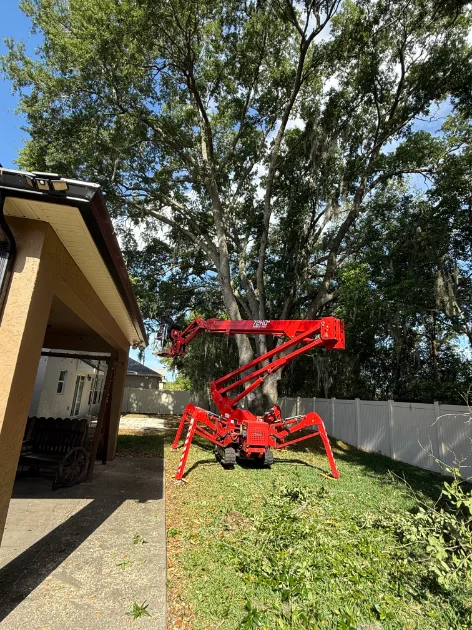
Large oak work requires planning around homes, landscaping, driveways, and access.
Large oak trees often grow in the most difficult part of a property — directly beside homes, over driveways, above landscaping, near fences, or behind pools and screen enclosures.
That makes the way the work is performed just as important as deciding which branches or trees need attention.
At Kevin’s Tree Service, our KTS Property Shield™ approach focuses on thoughtful access planning, controlled work when necessary, organized debris handling, and protective measures around vulnerable areas of the property.
For particularly difficult removals, equipment such as aerial lifts, loaders, cranes, and grapple saw crane equipment may allow sections of a tree to be controlled rather than simply dropped into the yard.
Best advice: When comparing tree-care estimates, consider more than how many limbs will be removed. Experience, equipment, insurance, pruning standards, cleanup, and how the company intends to protect your property all matter.
Have Questions About an Oak Tree on Your Property?
Whether you have a large live oak you want to preserve, an aging laurel oak you are concerned about, or simply do not know what kind of oak you have, our team can evaluate the tree and explain the available options.
Kevin’s Tree Service provides professional oak tree trimming, tree removal, stump grinding, and arborist-led tree care throughout Orlando and Central Florida.
Florida Oak Tree FAQs
What are the most common oak trees in Central Florida?
How long do live oak trees live?
How long do laurel oak trees live?
How long do water oak trees live?
Which is stronger, a live oak or laurel oak?
How can I tell a live oak from a laurel oak?
Why is my live oak dropping leaves?
Does Spanish moss kill oak trees?
Are mushrooms growing on an oak tree dangerous?
Is a hollow oak tree automatically dangerous?
Should I cut oak roots that are lifting my driveway?
Should oak trees be thinned before hurricane season?
Should large oak limbs over my roof be removed?
When should an oak tree be removed?
Is an old live oak worth saving?
Who should evaluate a large oak tree?
About the Information in This Guide
This guide combines our experience working with oak trees throughout the Orlando area with published tree-care information from the University of Florida Institute of Food and Agricultural Sciences (UF/IFAS) and accepted arboricultural practices.
Oak species characteristics such as mature size, expected lifespan, growth habits, and general wind resistance describe typical trees and should not be used as a substitute for evaluating the condition of an individual tree.
Helpful resource: Learn more about Florida oak species through UF/IFAS Gardening Solutions – Florida Oaks.